Acoustophoretic Assembly (Ph.D.)

I spent years moving objects with sound for my PhD. With potential applications in smart manufacturing and 3D printing, this interdisciplinary project involved fluid mechanics, nonlinear acoustics, mass transfer, and design.
Click here to see more information about this work.
Grad Student Coaching Program

This work was featured on MIT News in November 2023.
As Lead Facilitator for the MIT MechE Graduate Student Coaching Program, I was responsible for developing the in-person aspects of the program as MIT recovered from the Covid-19 pandemic shutdown. Additionally, I created and fundraised for the Open Conversation Series and the Coaching Skills for Engineers workshop.
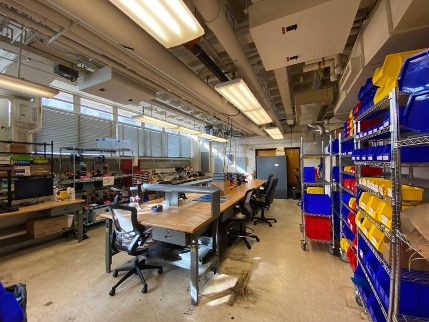
Hands on learning opportunities for smart manufacturing are sparse. Companies generally do not allow students to experiment within their factories – it’s too expensive and too risky. Even data about production rates are often proprietary and cannot be freely used for class projects. Thus, the FrED (Fiber Extrusion Device) Education Factory is being developed at MIT to create opportunities for hands-on learning for undergrad and graduate students. As staff at the FrED Education Factory, I provide mentorship to the students, learn how to create experiential learning experiences for engineering, and help publicize the factory at conferences.
I am applying my new skills to developing an AR/VR workshop focused on manufacturing, as I also learn AR/VR. In this fast moving field, the tools used for AR/VR development today may become obsolete in a few years. The content focuses on “how to think like an AR/VR developer” and understanding the fundamentals of creating assets and interactions.
The work by the first team of students was profiled on MIT News.
AI for Dental Scanning
Dental aligners have become popular in orthodontics to correct a wide range of dental misalignments. Traditionally, dentists took a mold of the patient’s teeth to create the aligners. Today, many dentists choose to 3D scan their patient’s teeth using handheld wands. In this project, I used Python and Tensorflow to train and evaluate neural networks for processing the dental scan images. Over the course of the project, I was able to increase the accuracy of the AI system 5x.
Molecular Dynamics Simulations of Heat Transfer in Bulk Octane
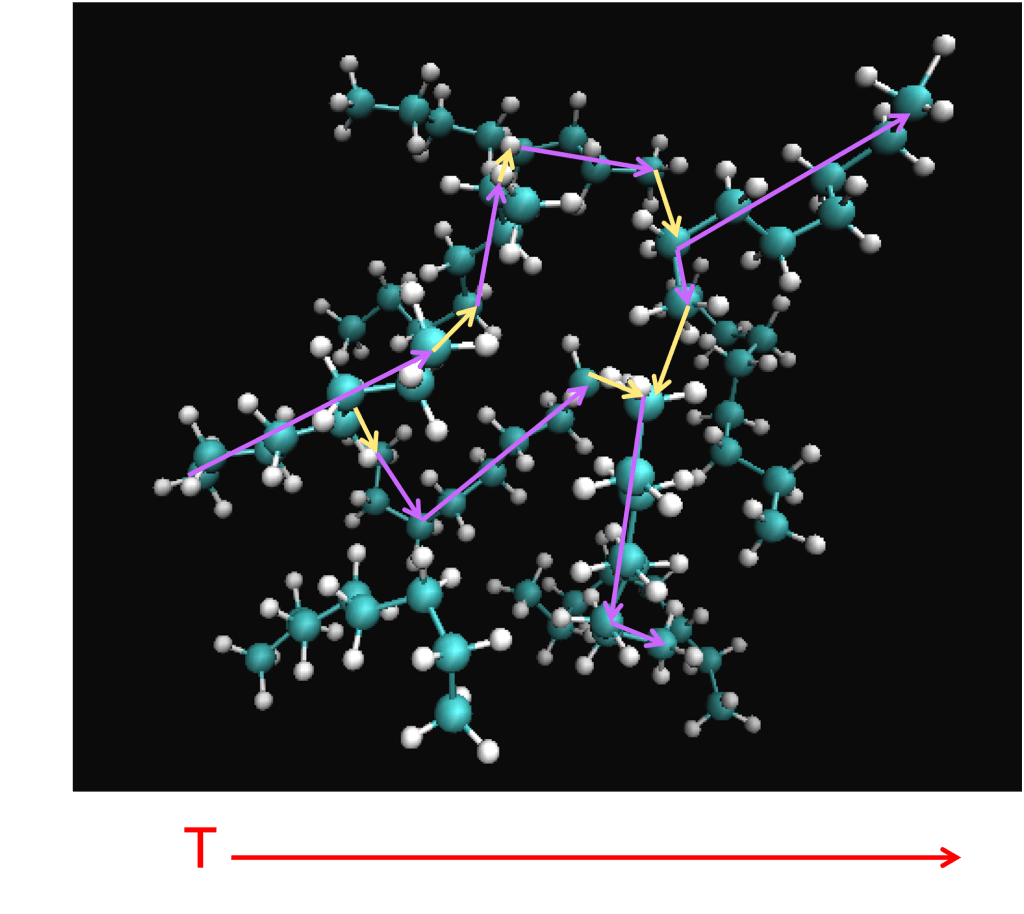
Fluids are important components in heat transfer systems. Understanding heat conduction in liquids at the atomic level would allow better design of liquids with specific heat transfer properties. However, heat transfer in molecular chain liquids is a complex interplay between heat transfer within a molecule and between molecules.
In my master’s thesis work, I used molecular dynamics to model heat transfer within bulk octane. I used the Green-Kubo formula to calculate thermal conductivity of liquid octane from equilibrium molecular dynamics. Then, I split the total thermal conductivity into effective thermal conductivities for the different types of atomic interactions in the system. I showed that for octane, the thermal resistance within a molecule is about the same as the resistance between molecules.
For additional information, see my master’s thesis: “Equilibrium Molecular Dynamics Study of Heat Conduction in Octane” https://dspace.mit.edu/handle/1721.1/97858
Thermally Regenerative Electrochemical Systems for Harvesting Waste Heat

Low-grade waste heat can be converted to electricity using the thermally regenerative electrochemical cycle (TREC). In TREC, the electrochemical cell is charged at a lower voltage by increasing the temperature of the cell. Then, the cell is cooled down and discharged at a higher voltage, thus converting thermal energy to electrical energy. In this project, I made pouch cells, built an apparatus to heat and cool the cells, and measured the temperature coefficient of the cells. I also used density functional theory to predict the temperature coefficient of the LiCoO2 system.
For additional information see: Y. Yang, J. Loomis, H. Ghasemi, S.W. Lee, Y. J. Wang, Y. Cui, and G. Chen, “A Membrane-free Battery for Harvesting Low-Grade Thermal Energy,” Nano Letters, 14, 6578 (2014) https://doi.org/10.1021/nl5032106, https://dspace.mit.edu/handle/1721.1/99726
 Y. Jenny Wang, PhD